Node.js Backend: Express, APIs & Auth — From Startup to Hardened Service
This course includes
- 10 lessons across 2 modules
- Hands-on coding exercises
- Downloadable resources & code
- Certificate of completion
- 12 months of access
Why This Course?
The internet is awash with "how-to" guides for building a Node.js API, but few prepare you for the gnawing anxiety of operating that API at 3 AM when a critical dependency fails. Most curricula teach the happy path; this course reveals the ditches, the detours, and the dead ends. You'll learn not just to build a Node.js backend with Express, but to fortify it against the inevitable chaos of production. We move beyond theoretical discussions of "scalability" and "resilience" to the concrete mechanisms: how Kafka's ISR shrinks under broker lag, why retries are the leading cause of cascading failure, and what clock skew silently does to lease-based leadership. By the end, you won't just have a working API; you'll have the muscle memory for debugging, securing, and hardening it against the pressures of real-world traffic and failure.
What You'll Build
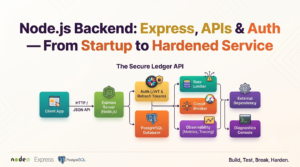
You will construct "The Secure Ledger API," a single, continuously evolving backend service for recording and retrieving immutable transaction-like events. Starting as a minimal Express server, it will progressively gain robust data persistence via PostgreSQL, secure authentication and fine-grained authorization using JWTs and refresh tokens, and advanced resilience patterns like circuit breakers and rate limiting. The final system will be instrumented with production-grade observability (metrics, tracing), capable of withstanding simulated dependency failures, gracefully degrading under load, and providing the diagnostic data needed to diagnose and recover from cascading failures on your local machine.
Who Should Take This Course?
This course is designed for anyone who needs to build or understand modern backend services, from the ground up to production readiness.
Software Engineers & Developers: Gain practical experience building a secure, resilient Node.js API, understanding the trade-offs in design and implementation that aren't obvious until systems break. This prepares you for mid-level backend roles.
Systems Programmers & SREs: Explore the failure modes and recovery strategies for a typical API service, learning how to instrument for observability and design for resilience against real-world incidents.
Software Architects & Designers: Develop a deeper intuition for the operational costs and architectural complexities of API design, authentication, and error handling, enabling more informed system design choices.
Product Managers: Acquire the technical vocabulary and understanding of system constraints (e.g., consistency models, security implications, operational overhead) to make better-informed feature and roadmap decisions.
What Makes This Course Different?
Our defining trait: every single lesson ends with the learner having built, run, tested, and broken a real working system on their own machine. This course is structured as a dependency graph, not a topic list; each day builds directly on the previous, culminating in one continuously-evolved system. We integrate "failure days" into every module, where you deliberately inject chaos—killing processes, partitioning networks, saturating resources—to observe and fix the emergent failure modes. We teach the unglamorous but critical aspects of production systems: configuration management, schema evolution, backpressure, and the on-call observability that keeps systems alive. This isn't theoretical; it's the operational reality of distributed systems.
What's Included
Prerequisites
You should have:
A solid understanding of JavaScript fundamentals, including asynchronous programming (async/await) and module systems.
Basic familiarity with HTTP methods (GET, POST, PUT, DELETE) and status codes.
Comfort using the command line.
A local development environment capable of running Node.js and installing Docker (for PostgreSQL, though a locally installed PostgreSQL is also an option).
Not required: Prior experience with Node.js, Express, databases, or authentication systems. We build from the ground up.
This course includes
- 10 lessons across 2 modules
- Hands-on coding exercises
- Downloadable resources & code
- Certificate of completion
- 12 months of access