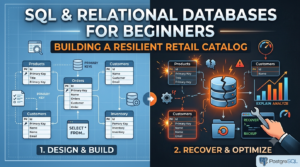
SQL & Relational Databases for Beginners: Building a Resilient Retail Catalog
This course includes
- 37 lessons across 3 modules
- Hands-on coding exercises
- Downloadable resources & code
- Certificate of completion
- 12 months of access
Why This Course?
Most "beginner" SQL courses teach you SELECT * FROM table; and call it a day. They gloss over why relational databases were invented, how they actually guarantee your data won't vanish, or what happens when your application tries to update the same record 100 times concurrently. This course bridges the painful gap between theoretical SQL syntax and the messy reality of production systems. You won't just learn to query data; you'll learn to design schemas that scale, optimize queries that choke, and recover databases that crash. You'll understand the hidden costs of convenience and the fundamental trade-offs that every database engineer makes, preparing you not just to use a database, but to reason about its behavior under duress.
What You'll Build
Across these 8 lessons, you will continuously evolve The Resilient Retail Catalog & Order System (RROCS). Starting as a single-table inventory, it will grow into a multi-table, multi-user system capable of managing products, customers, and orders. By the final day, your RROCS will be a robust, locally-deployed PostgreSQL database that can reliably store and retrieve data, handle concurrent transactions, survive process crashes without data loss, recover from full data deletion via backups, and report on its own performance bottlenecks. You'll have a working, observable system that demonstrates practical solutions to common database challenges, ready to be scaled or integrated into a larger application.
Who Should Take This Course?
Software Engineers & Developers: Move beyond ORM defaults. Understand why your queries are slow, design resilient data access patterns, and debug database-related issues with confidence. Learn the foundational concepts behind the data stores you rely on daily.
Systems Programmers & SREs: Gain practical experience with database recovery, backup strategies, performance monitoring (using
EXPLAIN ANALYZEand logs), and incident response for data persistence layers. Understand the guarantees (and limitations) of ACID properties.Data Engineers & Analysts: Deepen your understanding of schema design, indexing strategies for analytical queries, and the underlying mechanisms that ensure data integrity and consistency for your pipelines.
Software Architects & Designers: Develop a robust mental model for relational data, transaction semantics, and the trade-offs involved in designing scalable and resilient data tiers. Equip yourself to make informed decisions about data storage.
Product Managers: Acquire the technical vocabulary and understanding of database capabilities (and failure modes) to articulate product requirements, assess feature complexity, and make informed decisions regarding data consistency, performance, and recoverability.
QA Engineers: Learn to identify and test for data integrity issues, concurrency problems, and recovery scenarios, improving the robustness of your test plans.
What Makes This Course Different?
This course is designed as a continuous build, not a series of disconnected exercises. Every lesson builds directly upon the previous, evolving RROCS into a production-grade (albeit laptop-scale) system. You'll experience failure days where you deliberately break the system—killing processes, corrupting data, saturating resources—and then meticulously observe and fix the resulting chaos. This hands-on approach, grounded in dependency-graph curriculum design, ensures that you don't just memorize syntax but internalize the critical "So What?" behind every design choice. We'll explore the often-unspoken truths of database engineering: why fsync might lie, the silent killers of clock skew in distributed systems (even if we're local, the principles apply), and the practical implications of "eventually consistent" versus "strongly consistent" in a relational context. You'll leave with a system you built, broke, and fixed, and the production-honest insights to back it up.
What's Included
Prerequisites
Basic familiarity with a command-line interface (CLI).
Comfort with fundamental programming concepts (variables, loops, functions) in any language.
A laptop with at least 8GB RAM and sufficient disk space (50GB+ recommended).
No prior SQL or database experience is required. We start from first principles.
This course includes
- 37 lessons across 3 modules
- Hands-on coding exercises
- Downloadable resources & code
- Certificate of completion
- 12 months of access