Distributed Key Value Store : DurableKV
This course includes
- Hands-on coding exercises
- Downloadable resources & code
- Certificate of completion
- 12 months of access
Why This Course?
Most backend development courses teach you how to build a service that works. This course teaches you how to build a service that survives. The gap between a functional prototype and a production-grade system that sustains hundreds of millions of requests per second, endures network partitions, and recovers gracefully from hardware failure is vast. It’s filled with subtle, often counter-intuitive trade-offs, operational nightmares, and the hard-won lessons of engineers who've carried the pager through the night.
This course bridges that gap. We won't just implement algorithms; we'll break them. We won't just deploy services; we'll watch them fail under duress and learn to diagnose the symptoms. You'll move beyond "happy path" development to understand the brutal realities of distributed systems: the lies fsync can tell, why retries are often the leading cause of cascading failure, how clock skew silently breaks lease-based leadership, and why "eventually consistent" is a promise, not a guarantee. You'll emerge with the ability to design, build, and — critically — operate backend systems that are not just correct, but resilient, scalable, and observable under real-world conditions.
What You'll Build
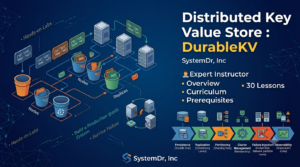
You will continuously evolve a single, production-inspired distributed key-value store, which we'll call DurableKV. Starting as a simple, in-memory HTTP service on Day 1, DurableKV will progressively gain persistence, replication, tunable consistency, partitioning, dynamic cluster membership, and advanced observability. By Day 30, your DurableKV cluster will be capable of surviving multiple node failures, network partitions, and resource saturation events, maintaining data availability and consistency guarantees, and providing rich operational insights on your local machine, mimicking the architecture of systems like Dynamo and Cassandra.
Who Should Take This Course?
This course is meticulously designed for a broad spectrum of technical professionals seeking to understand the deep mechanics of production backend systems:
Software Engineers & Developers: You'll gain a concrete understanding of distributed systems patterns, build hands-on experience with resilience techniques, and learn to write code that performs reliably under load, preparing you for senior and staff-level backend roles.
Systems Programmers & Engineers: Deepen your understanding of how high-performance, fault-tolerant systems are constructed from first principles, from network protocols to storage engines.
Software Designers & Architects: Acquire a practical framework for evaluating architectural trade-offs (consistency vs. availability, latency vs. durability) with real-world implications, moving beyond theoretical diagrams to actionable design decisions.
Product Managers: Develop the vocabulary and intuition to make informed decisions about product features involving data consistency, availability, and operational cost, understanding the engineering complexities behind "eventual consistency" or "high availability."
SREs & DevOps Engineers: Learn to anticipate failure modes by building and breaking systems yourself. You'll gain practical experience in designing for observability, crafting effective alerts, and building robust runbooks for common distributed system failures.
QA Engineers: Understand the complex failure scenarios in distributed systems, enabling you to design more comprehensive test plans that go beyond functional correctness to stress resilience and data integrity.
Engineering Managers: Gain a deeper appreciation for the technical challenges and operational overhead of building and maintaining scalable backend infrastructure, empowering you to better support your teams and estimate project timelines.
What Makes This Course Different?
This course is built on a "learn by doing, break, and fix" philosophy. Every lesson is a hands-on lab where you write, run, test, and critically, break a real working system on your own machine. Unlike theoretical courses or "toy project" tutorials, you will continuously build one single, evolving production-grade system from Day 1 to Day 30. We follow a dependency-graph curriculum, ensuring each day's work builds directly on the previous, leading to a continuously integrated, fully functional artifact.
Crucially, this curriculum embeds dedicated failure days where you deliberately introduce chaos – killing processes, partitioning networks, corrupting data, saturating resources – to observe, diagnose, and fix the resulting outages. This experience is invaluable; engineers remember what they broke and fixed far more vividly than what they read. We also embrace a "production-honest" approach, including the often-overlooked but vital aspects of real systems: configuration management, schema evolution, rolling upgrades, backpressure mechanisms, capacity planning, and the on-call observability that makes operating these systems possible.
What's Included
Prerequisites
- Basic understanding of programming
- Willingness to learn
This course includes
- Hands-on coding exercises
- Downloadable resources & code
- Certificate of completion
- 12 months of access