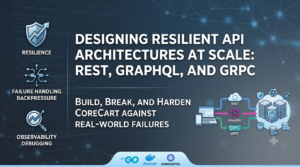
Designing Resilient API Architectures at Scale: REST, GraphQL, and gRPC
This course includes
- 75 lessons across 4 modules
- Hands-on coding exercises
- Downloadable resources & code
- Certificate of completion
- 12 months of access
Why This Course?
Most API design courses are shallow. They teach you how to write a basic REST controller, how to define a GraphQL schema, or how to compile a Protocol Buffer (Protobuf) file in a clean-room environment. They assume the network is reliable, clients are well-behaved, and schemas never change.
In production, these assumptions fail catastrophically. Client applications run over lossy cellular networks and send malformed, nested queries that saturate your database. Internal services experience transient network partitions, causing cascading retry storms that bring down entire clusters. Teams deploy independent updates daily, leading to silent schema drift that corrupts production data.
This course bridges the gap between clean-room API specifications and production-grade resilience. You will not just learn the syntax of REST, GraphQL, and gRPC; you will learn how to design, implement, and run them at hyperscale. You will discover how gRPC handles multiplexing (sending multiple requests over a single connection simultaneously), how GraphQL gateway layers introduce latency penalties, and why REST remains the standard for public-facing, edge-cached boundaries. By the end of this course, you will have designed and stress-tested an API ecosystem that degrades gracefully under extreme load and survives real-world failures.
What You'll Build
You will build CoreCart, a federated, high-throughput inventory allocation, pricing, and order processing engine. The system utilizes a hybrid architecture: gRPC handles low-latency, internal service-to-service communication; GraphQL serves as the client-facing gateway that aggregates data from multiple backends; and REST exposes idempotent (repeatable without side effects), highly cacheable public endpoints for third-party integrations.
Across the 8 days, you will evolve this system from a single gRPC endpoint into a multi-service, resilient API mesh. Running entirely on your local machine using Docker, Go (or your preferred backend language), and standard open-source tooling, CoreCart will be subjected to automated load tests. By the final day, your system will sustain 5,000 requests per second, survive simulated network partitions, and gracefully shed excess load when resources are saturated.
Who Should Take This Course?
Software Engineers & Systems Programmers: You will move beyond writing simple endpoints to building high-performance, production-grade network services. You will write code that manages connection pools, handles backpressure (signaling a sender to slow down to avoid overwhelming a receiver), and prevents resource exhaustion.
Systems Engineers & SREs: You will learn how to debug API failures under load, configure resilient timeouts, design circuit breakers, and implement observability hooks that expose the root cause of cascading failures.
Software Architects: You will gain a concrete trade-off framework for choosing REST, GraphQL, or gRPC based on latency budgets, cacheability requirements, and organizational team structures.
Product Managers & Technical Writers: You will master the vocabulary of API contracts and compatibility, enabling you to make informed decisions about feature deprecation, versioning strategies, and the operational costs of API performance.
What Makes This Course Different?
The Dependency-Graph Design: You will not build 8 disconnected toys. Every day consumes an artifact built on a previous day. A bug introduced on Day 2 will manifest as a failure under load on Day 8.
Mandatory Failure Days: You will spend dedicated sessions deliberately breaking your system. You will saturate CPUs, trigger network partitions, and inject malicious payloads to observe how your API boundaries respond.
Production-Honest Focus: We do not skip the tedious parts of engineering. You will write code to handle schema evolution, manage client-side retries with jitter (randomized delays to prevent synchronized request spikes), and compute query complexity before execution.
What's Included
Prerequisites
Required: Familiarity with basic network concepts (IP, TCP, HTTP) and a working knowledge of any backend programming language (Go, Rust, Java, C#, Python, or Node.js).
Tooling: A local development machine with Docker, curl, and a load-testing tool (such as k6 or locust) installed.
Not Required: Prior experience with gRPC or GraphQL is not necessary; we build these from the ground up. No paid cloud accounts are required.
This course includes
- 75 lessons across 4 modules
- Hands-on coding exercises
- Downloadable resources & code
- Certificate of completion
- 12 months of access