Master the system design Interview: The 6-Step Time-Boxed Blueprint Stop losing L5+ offers at Minute 30. Internalize the rhythm, master the trade-offs, and signal true seniority. Why Most Engineers Fail...
Master the system design Interview: The 6-Step Time-Boxed Blueprint
Stop losing L5+ offers at Minute 30. Internalize the rhythm, master the trade-offs, and signal true seniority.
Why Most Engineers Fail system design Interviews
It isn’t a lack of technical knowledge—it’s a lack of structure and time management.
Most candidates jump straight to drawing boxes and arrows without locking in requirements, estimating capacity, or defining clear contracts. By the time minute 30 arrives, they still haven’t drawn an architecture, leaving the interviewer no choice but to reject them.
Are you making these junior mistakes?
The Hand-Wave: Saying “We’d just use Kafka” without naming failure modes, SLOs, or monitoring signals.
The Premature Scale: Picking NoSQL “because scale” without identifying the access pattern first.
The Decorator: Running capacity calculations and never referencing them again.
The Scope Trap: Drawing 15 microservices upfront instead of starting simple.
The Framework: A Map Tied to Interview Scoring
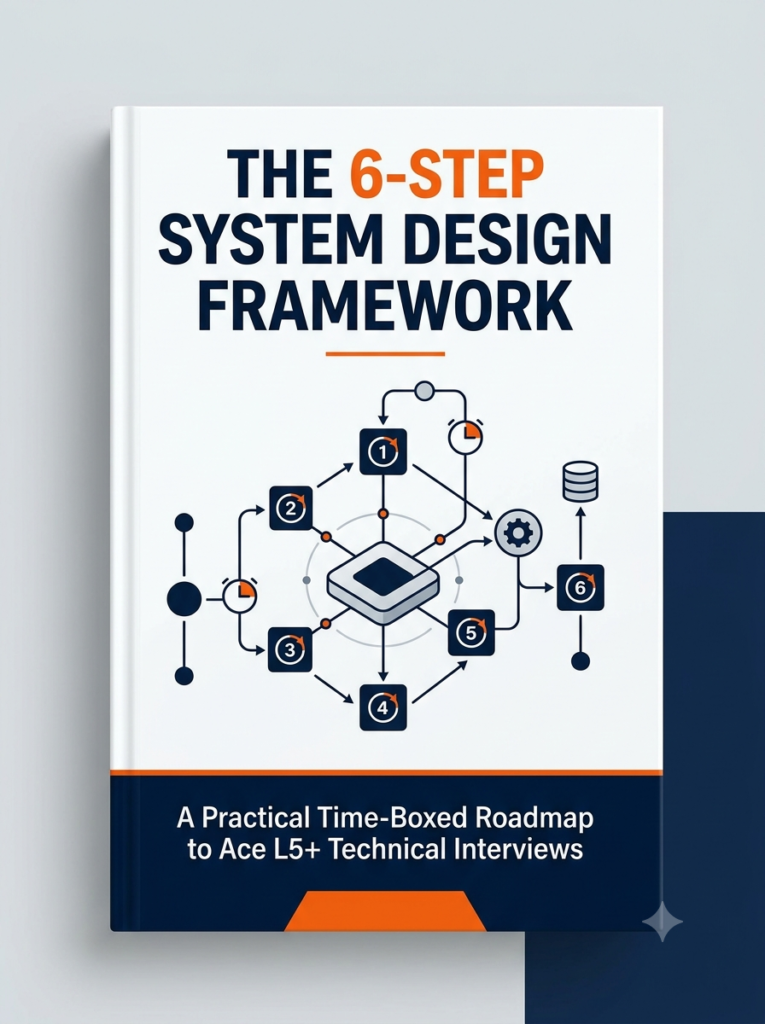
This 6-step system is engineered around what L5+ interviewers actually look for. Learn the exact timing budget to hit every milestone with confidence:
Step
Focus Area
Time
The Senior Signal
1
Functional + Non-Functional
3–5 min
Pin 2 functional and 2 non-functional requirements to the board as the lens for every trade-off.
2
Capacity Estimation
3–5 min
Calculate numbers within an order of magnitude; ensure every number justifies a choice.
3
API Design
3–5 min
Commit to an interaction model with explicit endpoints before drawing boxes.
4
Data Model
5–7 min
Define tables, keys, indexes, and sharding strategies based on access patterns.
5
High-Level Architecture
10 min
Walk one complete read flow and write flow sequentially across client, cache, queue, and DB.
6
Deep Dive
15–20 min
Tackle the load-bearing sub-problem—hot keys, multi-region, idempotency, or quorum.
The Secret Weapon: The Silent Step 7
The difference between a Hire and a Strong Hire happens in the final 2 minutes.
Step 7 is where you name two unresolved failure modes and define the exact conditions under which you would revisit your design. This proves to the interviewer that you understand engineering reality: no design is ever finished, only optimized for current constraints.
Steal These Battle-Tested Senior Moves
Number $\rightarrow$ Consequence:“At 10K writes/sec, sync DB writes blow my latency budget, so I’m introducing an async queue.”
Pick + Revisit Condition:“I’ll default to Snowflake for IDs. If predictability becomes a security concern, I’ll switch to pre-allocated ranges.”
Name the SLO:“I’m targeting p99 < 100ms, which means no synchronous DB lookup on the hot path.”
Name the Monitoring Signal:“My primary alert is cache hit ratio < 90%, because that’s the threshold where DB load doubles.”
What You’ll Get
The Complete Step-by-Step Guide: Detailed breakdowns of every step, checkpoint, and time-boxing rule.
The Whiteboard Prep Checklist: How to spend your first 2 minutes setting up the board to buy 48 minutes of flawless execution.
Printable Cheatsheet PDF: A high-resolution roadmap to tape to your wall so the rhythm becomes second nature.
Get Instant Access Today
Stop over-complicating system design. Lock in your structure, pass the interview, and land your next senior role.