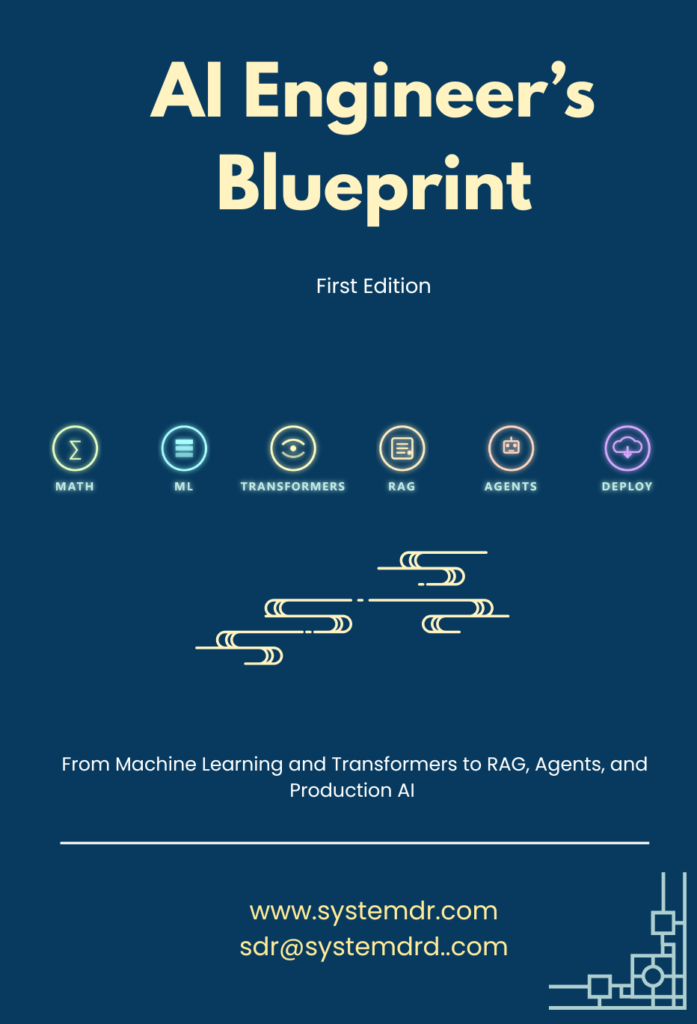
AI Engineer’s Blueprint
Master the Blueprint of Modern AI Engineering Go Beyond Prompting and Learn How Real AI Systems Are Built, Scaled, and Deployed in Production. AI engineering is no longer about calling...
Master the Blueprint of Modern AI Engineering
Go Beyond Prompting and Learn How Real AI Systems Are Built, Scaled, and Deployed in Production.
AI engineering is no longer about calling APIs or wrapping chatbots. The modern AI engineer is expected to understand transformers, retrieval systems, fine-tuning strategies, agent reliability, production infrastructure, and the economics of deploying intelligence at scale. Whether you are aiming to become an AI Engineer, ML Engineer, Applied AI Architect, or GenAI Product Builder, The AI Engineer’s Blueprint gives you the complete roadmap from mathematical foundations to production-grade autonomous systems.
The AI Landscape Has Changed. Have You?
Between 2024 and 2026, AI engineering evolved from experimentation into infrastructure engineering. Building AI systems today means understanding not only models, but retrieval pipelines, observability, inference cost, alignment risks, and deployment reliability.
This book was written for engineers who want to understand why modern AI systems work — not just how to call them.
The industry no longer rewards surface-level knowledge. Companies now expect engineers to reason about tokenisation costs, transformer stability, retrieval precision, agent failure modes, GPU memory bottlenecks, and production monitoring. Knowing how to prompt a model is not enough. Knowing how to architect and operationalise intelligence is the new competitive edge.
What’s Inside the Blueprint?
This roadmap is structured as a progression from first principles to production systems, helping you build deep intuition before scaling to real-world AI architectures.
Part I: Foundations Before the Hype
Build the mathematical and engineering intuition that modern AI systems rely on.
Chapter 0-1: Set up a professional AI development environment and master the mathematical foundations behind neural networks, embeddings, probability, and optimisation.
Chapter 2-3: Learn real-world data engineering, preprocessing pipelines, classical machine learning, evaluation strategies, and why traditional ML still dominates many enterprise workloads.
Chapter 3.5: Bridge the gap from Scikit-learn abstractions to raw PyTorch training loops and autograd internals.
Part II: Transformers, Fine-Tuning, and Model Engineering
Move from using models to understanding and building them.
Chapter 4: Build a GPT-style transformer from scratch in PyTorch while understanding tokenisation, attention, Pre-LN architectures, and training stability.
Chapter 5: Master LoRA, QLoRA, parameter-efficient fine-tuning, and the reasoning behind low-rank adaptation.
Chapter 5.5: Treat prompt engineering as an engineering discipline with structured outputs, evaluation harnesses, and system prompt architecture.
Part III: Production AI Systems
Learn how modern AI applications actually operate at scale.
Chapter 6: Build production-grade RAG systems with hybrid retrieval, re-ranking, chunking strategies, and evaluation pipelines.
Chapter 7: Engineer reliable AI agents with LangGraph, retry systems, failure detection, and human escalation strategies.
Chapter 8: Understand MLOps, inference profiling, GPU optimisation, drift monitoring, quantisation, latency analysis, and production cost control.
Part IV: Frontier AI, Reliability, and the Future
Understand the systems shaping the next generation of AI.
Chapter 9: Analyze reasoning models, test-time compute scaling, and the economics of slow-thinking AI systems.
Chapter 10: Separate real-world robotics deployment from marketing demos and understand the VLM → VLA → World Model stack.
Chapter 11: Explore alignment, RLHF, Constitutional AI, interpretability, and the unresolved challenges of AI safety.
Part V: Career Growth and Real-World Execution
Turn technical knowledge into career leverage.
Chapter 12: Follow five complete career roadmaps tailored for different technical backgrounds.
Appendices: Explore AI tooling ecosystems, portfolio project blueprints, architecture landscapes beyond transformers, and interview preparation frameworks.
What Makes This Book Different?
Most AI books teach isolated tools. This book teaches systems thinking.
Instead of hiding complexity behind abstractions, it explains the engineering trade-offs modern teams face every day:
- Why Pre-LN transformers replaced Post-LN architectures.
- Why RAG pipelines fail in production.
- Why agents break on long task chains.
- Why tokenisation directly affects infrastructure cost.
- Why monitoring hallucination rates matters as much as monitoring latency.
- Why most impressive AI demos collapse outside controlled environments.
Every chapter includes:
- Production-grade code examples
- Real architectural trade-offs
- Failure mode analysis
- “What We Don’t Know Yet” research sections
- Portfolio projects designed for real engineering interviews
Who Is This Book For?
This blueprint is designed for builders who want to move beyond tutorials and become genuinely capable AI engineers.
It is built for:
- Software Engineers transitioning into AI Engineering
- ML Engineers who want stronger systems and production expertise
- Backend Engineers building AI-powered platforms
- Developers tired of shallow “prompt engineering only” content
- Technical founders building AI-native products
- Students who want a practical path into modern AI infrastructure
Stop copying AI workflows.
Start engineering intelligent systems.