Docker: From Isolated Containers to Resilient Stacks
This course includes
- 28 lessons across 2 modules
- Hands-on coding exercises
- Downloadable resources & code
- Full GitHub repository access
- Certificate of completion
- 12 months of access
Why This Course?
Most Docker courses teach you the commands. This course teaches you the consequences of those commands. We bridge the painful gap between running a container and understanding why your "perfectly working" local setup explodes in production under load or network partitions. We don't just explain Dockerfiles; we show you how image layering can silently inflate build times, why localhost inside a container is a trap, and how seemingly innocent environment variables can leak sensitive data or create unrecoverable state. You'll learn not just how to use Docker, but why specific patterns are chosen in systems like Borg and Kubernetes, and the operational headaches they prevent. By the end, you'll be able to containerize complex applications, orchestrate them locally with Compose for development and testing, debug network issues with precision, and, crucially, understand the failure modes that turn a quiet night into a 3 AM pager storm.
What You'll Build
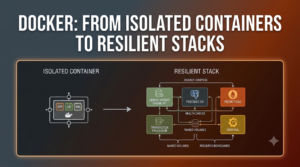
You will construct "The Ledger Insight Engine," a continuously evolving, multi-service application designed to simulate financial transaction processing. Starting from a single container, it will grow into a robust stack comprising a transaction producer, a processor, a database (PostgreSQL), and an api-server for querying. By the final day, your Ledger Insight Engine will run as a cohesive unit via Docker Compose, persist its data across restarts using named volumes, automatically recover from individual service failures through health checks, operate within defined resource boundaries, and be fully instrumented with Prometheus and Grafana for real-time observability. You will have a production-grade local development environment that mirrors the resilience and operational concerns of a distributed system.
Who Should Take This Course?
Software Engineers & Developers: Move beyond
docker runto understand the lifecycle, networking, and persistence patterns that make your applications robust and deployable. Learn to build efficient, secure Docker images and troubleshoot containerized applications with confidence, becoming a more effective contributor to CI/CD pipelines and production environments.Systems Programmers & SREs: Gain a deep understanding of Docker's primitives, network models, and resource isolation mechanisms. This course provides the foundation for debugging complex container issues, designing resilient service topologies, and preparing for the operational realities of Kubernetes and other orchestration platforms. You'll internalize the failure modes that lead to "interesting" incidents.
Software Architects & Designers: Develop a nuanced understanding of the trade-offs involved in containerization, from image size and build times to network topology and data persistence strategies. This will enable you to make informed decisions about service boundaries, deployment models, and the operational characteristics of your system designs.
Engineering Managers & Project Managers: Acquire the technical vocabulary and conceptual framework to understand the implications of containerization on development workflows, infrastructure costs, and operational complexity. Make better decisions about team tooling, deployment strategies, and project timelines.
QA Engineers & DevOps Engineers: Learn to reliably reproduce application environments, test service integrations, and simulate failure conditions within a consistent, containerized setup. This course provides the hands-on skills to build robust testing infrastructures and contribute to a resilient delivery pipeline.
What Makes This Course Different?
This course is defined by its relentless focus on building, breaking, and fixing. Every single lesson culminates in a runnable system or a reproducible failure on your local machine. We don't just list Docker commands; we explain the underlying Linux kernel primitives (namespaces, cgroups) that give containers their power, and the specific production incidents these mechanisms prevent (or cause, if misconfigured). You'll construct "The Ledger Insight Engine" incrementally, starting with a single container and evolving it daily into a multi-service, resilient application. We dedicate entire lessons to deliberately crashing, partitioning, and saturating your system, teaching you how to debug under pressure – the most valuable skill for any engineer. This curriculum is production-honest, covering the unglamorous but critical aspects like build caching, volume management, health check tuning, and the subtle ways clock skew or network latency can manifest as application failures.
What's Included
Repository
sysdr/docker-from-basics-to-production-p Private
Buy or enroll in this course to request access to its private GitHub repository.
Prerequisites
A laptop capable of running Docker Desktop (or Docker Engine on Linux) with at least 8GB RAM.
Basic command-line proficiency (navigating directories, running commands).
Familiarity with a modern programming language (e.g., Python, Node.js, Go, Java) to understand application code examples. No deep expertise required, just the ability to read simple HTTP servers and data processing scripts.
A conceptual understanding of client-server architecture.
Not required: Prior Docker experience, cloud accounts, Kubernetes knowledge, advanced distributed systems theory.
This course includes
- 28 lessons across 2 modules
- Hands-on coding exercises
- Downloadable resources & code
- Full GitHub repository access
- Certificate of completion
- 12 months of access