
Start building with us today.
Buy this course — $99.00Spring Boot Microservices: From Design to Deployment
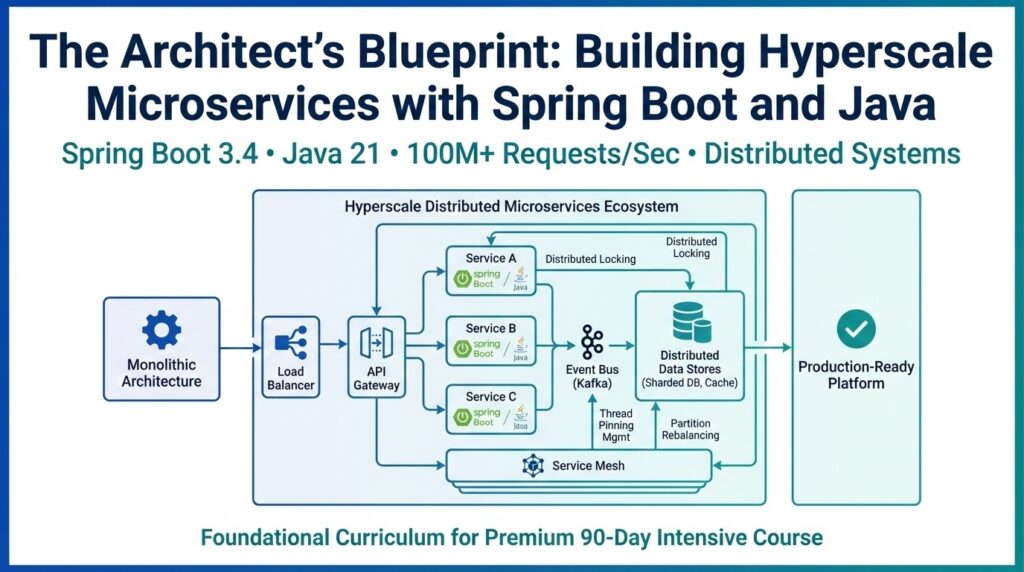
The Architect’s Blueprint: Building Hyperscale Microservices with Spring Boot and Java
The transition from a monolithic architecture to a distributed ecosystem is often characterized as a journey from simplicity to complexity. However, for systems handling 100 million requests per second, this complexity is not merely an architectural choice but a survival requirement. The modern engineer must move beyond basic REST controllers and simple database interactions to master the orchestration of hundreds of services, the nuances of distributed data consistency, and the performance characteristics of the underlying virtual machine. This report serves as the foundational curriculum for a premium, 90-day intensive course designed to bridge the gap between building a Minimum Viable Product (MVP) and architecting a production-ready, hyperscale platform.
Why This Course?
Mainstream resources often provide a fragmented view of microservices, focusing on localized implementation while ignoring the systemic challenges of distributed environments. This course is built on the hard-earned wisdom of architects from major fintech and big-tech firms, addressing the "hidden" challenges: thread pinning in virtual threads, Kafka partition rebalancing under load, and the race conditions inherent in distributed locking. By focusing on the Spring Boot 3.4 and Java 21 stack, the curriculum leverages the most advanced features of the JVM to simplify concurrency without sacrificing the performance required for global scale.
What You'll Build
The core of the learning experience is the construction of a high-performance "Microservices Ecosystem." This is not a toy project but a suite of production-grade services including an Identity and Access Management (Auth) service, a high-throughput Order management system, and a low-latency Inventory service. These services will communicate through a combination of synchronous RESTful APIs for immediate feedback and asynchronous messaging via Apache Kafka for eventual consistency and long-running business processes.
Who Should Take This Course?
The material is tailored for a diverse spectrum of professionals within the software lifecycle. Fresh computer science graduates will find the "intuition-first" approach accessible, while seasoned software architects and engineering managers will gain rare insights into production tuning and disaster recovery strategies. Product managers and UI/UX designers will benefit from a deep understanding of system constraints—such as the trade-offs between strong and eventual consistency—empowering them to make informed decisions regarding user experience and business logic. Quality assurance and Site Reliability Engineers (SREs) will master the advanced observability and testing patterns required to keep complex systems operational.
What Makes This Course Different?
Unlike standard tutorials, this curriculum imposes an "every day coding" constraint. Mastery is not achieved through passive observation but through the daily application of principles to a growing codebase. The course prioritizes the "wait faster" philosophy of Java 21’s virtual threads, moving away from the overhead of traditional thread pools and the complexity of reactive programming. Furthermore, it integrates industry-standard tools like Keycloak for security, OpenTelemetry for observability, and Redis for distributed coordination, providing a complete toolset for the modern engineer.
Key Topics Covered
The technical depth of the curriculum covers the entire lifecycle of a distributed system.
Prerequisites
A solid foundation in Java programming is essential, specifically focusing on the Long-Term Support (LTS) versions 17 or 21. Participants should be familiar with Object-Oriented Programming (OOP) principles, basic exception handling, and the Java Collections Framework. Understanding build tools like Maven or Gradle and the basics of containerization with Docker will accelerate the transition to the advanced modules.
Course Structure: The Logical Progression
The curriculum is divided into seven major sections, each building upon the previous one to guide the student from a localized service to a globally distributed platform.
Section 1: The Modern Core (Days 1-12)
The journey begins by mastering the internal mechanics of Spring Boot 3.4 and Java 21. Before distributing services, an engineer must understand how to optimize a single unit of execution. This includes the move to virtual threads, which allow for massive concurrency by decoupling Java threads from the underlying operating system threads.
Learning Objectives:
Quantify the throughput gains of virtual threads compared to traditional platform threads.
Implement Class Data Sharing (CDS) to reduce application warm-up times in serverless environments.
Architect the "Auth Service" as the initial perimeter of the ecosystem.
Section 2: Building the Distributed Perimeter (Days 13-24)
Once the core is established, the focus shifts to identity and the entry points of the system. In high-scale environments, security cannot be an afterthought; it must be centralized and scalable. Participants will integrate Keycloak to handle authentication and authorization across the suite of services.
Learning Objectives:
Configure a centralized Identity Provider (IdP) using Keycloak and OAuth2.
Implement an API Gateway to handle cross-cutting concerns like rate limiting and request routing.
Master token propagation to maintain security context across service boundaries.
Section 3: High-Scale Data and State (Days 25-38)
The Inventory service presents a unique challenge: managing high-contention resources. This section explores strategies beyond simple database transactions, focusing on how to prevent overselling during flash sales through soft reservations and lock-free journals.
Learning Objectives:
Differentiate between pessimistic, optimistic, and lock-free concurrency controls.
Design a "Soft Reservation" system that handles temporary holds without blocking database resources.
Implement Redis-based distributed locks (Redlock) for multi-service coordination.
Section 4: Asynchronous Resilience and Messaging (Days 39-52)
The Order service acts as the orchestrator of business value. To handle load spikes, the system must transition from synchronous calls to asynchronous messaging. This section deep-dives into Apache Kafka, focusing on the mechanics of exactly-once semantics to ensure no order is ever lost or duplicated.
Learning Objectives:
Implement the Saga Pattern (Orchestration) to manage distributed transactions.
Configure Kafka for high durability using acks=all and idempotent producers.
Apply the Transactional Outbox pattern to ensure atomicity between database updates and event publishing.
Section 5: Performance Engineering and Tuning (Days 53-65)
With the ecosystem built, the focus turns to squeezing every bit of performance from the stack. This involves tuning connection pools, garbage collection, and identifying bottlenecks through low-overhead profiling.
Learning Objectives:
Optimize HikariCP settings using the CPU-core formula: ![][image1].
Identify and resolve thread pinning issues caused by synchronized blocks in virtual thread environments.
Profile production workloads using Java Flight Recorder (JFR) and async-profiler.
Section 6: Advanced Testing and Observability (Days 66-78)
In a distributed system, traditional unit tests are insufficient. Section 6 introduces consumer-driven contract testing and full-stack observability, ensuring that services can evolve without breaking the ecosystem.
Learning Objectives:
Implement contract tests using Pact or Spring Cloud Contract to ensure API compatibility.
Build a production-ready observability stack with OpenTelemetry, Tempo, and Loki.
Correlate logs, metrics, and traces to reduce the Mean Time To Recovery (MTTR) during outages.
Section 7: Hyperscale Operations and SRE (Days 79-90)
The final section addresses the "Day 2" operations of running microservices at a global scale. This includes Kubernetes deployment patterns, multi-region failover, and zero-downtime database migrations.
Learning Objectives:
Design a multi-region active-active deployment to survive regional failures.
Execute zero-downtime schema updates using the "Expand and Contract" pattern.
Implement Horizontal Pod Autoscaling (HPA) based on domain metrics like Kafka lag.
Detailed Curriculum: 90 Days of Incremental Mastery
Section 1: The Modern Core
Day 1: Bootstrap and Lifecycle. Intuition: Understanding the Spring container's startup is the first step to optimization. Coding Task: Initialize the project with Spring Boot 3.4 and measure the "Time to First Request."
Day 2: Virtual Threads vs. Platform Threads. Intuition: Platform threads are heavy OS resources; virtual threads are lightweight JVM tasks. Coding Task: Implement a benchmark to create 1 million threads.
Day 3: Wait Faster: The Loom Philosophy. Intuition: Virtual threads "unmount" during I/O, allowing the carrier thread to work on something else. Coding Task: Build a service that makes 500 concurrent blocking REST calls.
Day 4: Class Data Sharing (CDS) and Startup Efficiency. Intuition: CDS avoids the need to repeatedly verify and load the same classes. Coding Task: Generate a CDS archive using jarmode=tools and measure startup gain.
Day 5: GraalVM and Native Images. Intuition: AOT compilation removes unused code and provides near-instant startup. Coding Task: Compile your service to a native binary.
Day 6: Domain-Driven Design (DDD) Boundaries. Intuition: Clear service boundaries prevent "distributed monoliths." Coding Task: Map out the aggregates for the Auth, Order, and Inventory contexts.
Day 7: Spring Modulith for Initial Velocity. Intuition: Start with a monolith, but enforce logical boundaries to make future splitting easy. Coding Task: Use Spring Modulith to verify dependencies between your modules.
Day 8: Advanced Spring Data JPA and Hibernate 7. Intuition: Lazy loading and the N+1 problem are the silent killers of scale. Coding Task: Implement an "Order History" query with optimized Fetch Joins.
Day 9: The Auth Service Architecture. Intuition: Auth is the gateway to every other service. Coding Task: Build the basic User entity and repository.
Day 10: Exception Handling in Distributed Systems. Intuition: Error codes must be consistent across the ecosystem. Coding Task: Implement a global @ControllerAdvice with standardized error DTOs.
Day 11: Validation and Data Integrity. Intuition: Trust nothing; validate everything at the perimeter. Coding Task: Implement Bean Validation for the registration flow.
Day 12: Section Review: Performance Benchmarking. Coding Task: Use JMeter to test the throughput of the single-service Auth MVP.
Section 2: Building the Distributed Perimeter
Day 13: Centralized Identity with Keycloak. Intuition: Managing users is hard; delegating it to a hardened provider is smart. Coding Task: Spin up Keycloak in Docker and create a new Realm.
Day 14: OAuth2 and OpenID Connect (OIDC). Intuition: Standardizing how we identify users and clients. Coding Task: Configure a confidential client for your microservices.
Day 15: Spring Security and the Resource Server. Intuition: Your service shouldn't check passwords; it should check tokens. Coding Task: Protect an endpoint using JWT validation.
Day 16: Role-Based Access Control (RBAC). Intuition: Permissions should be fine-grained and managed in the IdP. Coding Task: Implement @PreAuthorize based on Keycloak roles.
Day 17: Token Propagation Strategies. Intuition: How to pass the user's identity when Service A calls Service B. Coding Task: Use SecurityContextHolder to pass a Bearer token in a WebClient call.
Day 18: API Gateway: The Single Entry Point. Intuition: Hide your services behind a single URL to simplify the client experience. Coding Task: Set up Spring Cloud Gateway.
Day 19: Global Rate Limiting. Intuition: Protect your system from "noisy neighbors" or abusive clients. Coding Task: Implement a Redis-backed request rate limiter.
Day 20: Circuit Breakers and Fallbacks. Intuition: If the Auth service is down, don't let the whole system hang. Coding Task: Implement a Resilience4j circuit breaker on the Gateway.
Day 21: Service Discovery with Eureka. Intuition: Services should find each other dynamically without hardcoded IPs. Coding Task: Register the Auth and Gateway services with Eureka.
Day 22: Client-Side Load Balancing. Intuition: The client should choose which instance to call to avoid a central bottleneck. Coding Task: Implement Spring Cloud LoadBalancer.
Day 23: Gateway Filters and Security. Intuition: Remove sensitive headers before requests enter your internal network. Coding Task: Write a custom gateway filter to sanitize headers.
Day 24: Section Review: Perimeter Security Audit. Coding Task: Verify that internal services cannot be accessed directly without going through the Gateway.
Section 3: High-Scale Data and State
Day 25: The Inventory Problem: Concurrency and Race Conditions. Intuition: Two users buying the last item at the same time is the ultimate test. Coding Task: Create a high-concurrency test that causes "overselling."
Day 26: Optimistic Locking with Versioning. Intuition: Assume no conflict, but check for it before saving. Coding Task: Implement @Version in your Inventory entity.
Day 27: Pessimistic Locking for High Contention. Intuition: Lock the row so no one else can touch it—safe but slow. Coding Task: Use PESSIMISTIC_WRITE for a specific inventory update.
Day 28: Soft Reservations and Expiry. Intuition: Hold the item for 5 minutes during checkout; if they don't buy, let it go. Coding Task: Implement a "Soft Hold" table and a cleanup job.
Day 29: Lock-Free Reservations (The Journal Pattern). Intuition: Instead of updating a single number, record the "intent" to buy and sum them up. Coding Task: Implement a reservation journal.
Day 30: Redis as a Distributed Cache. Intuition: Moving state to memory is the only way to achieve sub-millisecond reads. Coding Task: Cache inventory lookups using @Cacheable.
Day 31: Cache Eviction and Consistency. Intuition: A stale cache is worse than no cache. Coding Task: Implement @CacheEvict on inventory updates.
Day 32: Distributed Locking with Redlock. Intuition: Coordination across multiple servers when you don't have a shared database. Coding Task: Implement a lock for "Warehouse Entry" using Redisson.
Day 33: Fencing Tokens and Correctness. Intuition: How to handle a process that wakes up after its lock has expired. Coding Task: Implement a monotonic token for your locking mechanism.
Day 34: Data Sharding: Horizontal Scaling. Intuition: When one database isn't enough, split your data across many. Coding Task: Design a sharding strategy for a multi-tenant inventory system.
Day 35: Read-Through and Write-Behind Caching. Intuition: Hide the database behind the cache for maximum speed. Coding Task: Implement a write-behind pattern for non-critical inventory logs.
Day 36: Handling Flash Sales: Queueing Strategies. Intuition: Don't let users hit the DB; put them in a queue first. Coding Task: Implement a "Virtual Waiting Room" using Redis.
Day 37: Multi-Tenant Data Isolation. Intuition: Keeping Customer A's data separate from Customer B's is a legal requirement. Coding Task: Implement a schema-per-tenant strategy.
Day 38: Section Review: Throughput Analysis. Coding Task: Benchmark the inventory service with 5,000 concurrent writes/sec.
Section 4: Asynchronous Resilience and Messaging
Day 39: Intro to Apache Kafka. Intuition: Messaging is about decoupling time—the producer doesn't wait for the consumer. Coding Task: Send a "Hello World" message to a Kafka topic.
Day 40: The Order Service MVP. Coding Task: Build the basic Order entity and a "Place Order" REST endpoint.
Day 41: Event-Driven Architecture (EDA) Patterns. Intuition: Shift from "I call you" to "I announce what happened." Coding Task: Publish an OrderCreated event.
Day 42: Transactional Outbox Pattern. Intuition: Ensure the Order is saved and the Event is sent—atomically. Coding Task: Implement an "Outbox" table and a polling publisher.
Day 43: Idempotent Consumer Implementation. Intuition: How to handle receiving the same "Payment Success" message twice. Coding Task: Implement a de-duplication log in the Order service.
Day 44: The Saga Pattern: Choreography Style. Intuition: Decentralized events—each service knows what to do next. Coding Task: Chain "Order" -> "Payment" -> "Inventory" via events.
Day 45: The Saga Pattern: Orchestration Style. Intuition: A central "Brain" directs the workflow—easier to debug. Coding Task: Build an OrderSagaOrchestrator.
Day 46: Handling Failures: Compensation Logic. Intuition: If the inventory is gone, we must refund the payment automatically. Coding Task: Write the RefundPayment consumer.
Day 47: Kafka Exactly-Once Semantics (EOS). Intuition: Zero messages lost, zero messages duplicated—guaranteed. Coding Task: Enable processing.guarantee=exactlyoncev2.
Day 48: Transactional Producers in Spring Kafka. Coding Task: Use KafkaTemplate.executeInTransaction for atomic multi-topic writes.
Day 49: Consumer Groups and Rebalancing. Intuition: How Kafka scales processing by splitting topics into partitions. Coding Task: Simulate a consumer joining and leaving a group.
Day 50: Retry Topics and Dead Letter Queues (DLT). Intuition: Don't block the whole highway because of one broken car. Coding Task: Implement a non-blocking retry with @RetryableTopic.
Day 51: Schema Evolution with Avro. Intuition: How to change your data format without breaking your consumers. Coding Task: Implement a schema registry and send an Avro-encoded event.
Day 52: Section Review: Resilient Order Flow. Coding Task: Kill the Inventory service mid-order and verify the Saga rollback.
Section 5: Performance Engineering and Tuning
Day 53: HikariCP: The King of Connection Pools. Intuition: Too many connections kill the DB; too few kill the app. Coding Task: Tune your pool size based on cores and monitor "Acquire Time."
Day 54: Thread Pinning: The Loom Achilles' Heel. Intuition: synchronized blocks lock OS threads—avoid them in virtual threads. Coding Task: Use -Djdk.tracePinnedThreads=full to find pinning in your app.
Day 55: Migrating to ReentrantLock. Intuition: ReentrantLock allows virtual threads to unmount safely. Coding Task: Replace a synchronized block with ReentrantLock.
Day 56: JVM Garbage Collection for Low Latency. Intuition: ZGC and Shenandoah focus on keeping pauses under 1ms. Coding Task: Switch to ZGC and monitor pause times under heavy load.
Day 57: Async-Profiler: Low-Overhead Insights. Intuition: Find where your CPU cycles are actually going in production. Coding Task: Generate a Flame Graph for your Inventory service.
Day 58: Performance Profiling with JFR. Intuition: Record the "black box" of the JVM and analyze it later. Coding Task: Capture a 5-minute JFR recording during a load test.
Day 59: Memory Leak Detection. Intuition: Small leaks over months become big crashes. Coding Task: Use VisualVM to find a simulated memory leak.
Day 60: I/O Optimization: Zero-Copy and Direct Buffers. Intuition: Moving data without touching the CPU is the ultimate speed hack. Coding Task: Discuss how Kafka uses sendfile for high throughput.
Day 61: HTTP/2 and gRPC Tuning. Intuition: Multiplexing many requests over one connection saves latency. Coding Task: Enable HTTP/2 in your Spring Boot app.
Day 62: Batching and Linger Time in Kafka. Intuition: Wait a few milliseconds to send a big box instead of many tiny envelopes. Coding Task: Tune linger.ms and batch.size for maximum throughput.
Day 63: Large Data Sets and Pagination. Intuition: Never return 10,000 rows; the network will choke. Coding Task: Implement Keysets (Seek Method) pagination.
Day 64: Content Delivery Networks (CDNs). Intuition: Cache data at the "Edge," closest to the user. Coding Task: Design a caching strategy for your Auth service's public keys.
Day 65: Section Review: The 100k TPS Challenge. Coding Task: Optimize the entire stack to handle 100,000 transactions per second locally.
Section 6: Advanced Testing and Observability
Day 66: The Observability Pillar: Metrics. Intuition: Metrics tell you that something is wrong. Coding Task: Export custom metrics to Prometheus via Micrometer.
Day 67: The Observability Pillar: Tracing. Intuition: Traces tell you where the request failed. Coding Task: Set up OpenTelemetry and trace a request across three services.
Day 68: The Observability Pillar: Logging. Intuition: Logs tell you why it failed. Coding Task: Implement structured JSON logging correlated with trace IDs.
Day 69: OpenTelemetry (OTel) Collector. Intuition: A central agent to aggregate and route your telemetry. Coding Task: Run an OTel Collector and send data to Tempo and Loki.
Day 70: Visualization with Grafana. Intuition: If you can't see it, you can't manage it. Coding Task: Build a dashboard showing "Service Health" and "P99 Latency."
Day 71: Distributed Tracing with Kafka. Intuition: How to follow a trace through a message queue. Coding Task: Propagate trace context through Kafka headers.
Day 72: Consumer-Driven Contract Testing (Pact). Intuition: The consumer defines the API requirements. Coding Task: Write a Pact test for the "Order -> Inventory" call.
Day 73: Provider Verification. Coding Task: Run the Pact provider test against your Inventory service.
Day 74: Spring Cloud Contract Stubs. Intuition: Run a "Mock" version of your dependency in your local tests. Coding Task: Generate and use a stub for the Auth service.
Day 75: Component and Integration Testing. Intuition: Test the service as a whole, including its DB and Message Queue. Coding Task: Use Testcontainers to run a full integration test.
Day 76: Chaos Engineering: Inducing Failure. Intuition: Test your system's resilience by breaking it on purpose. Coding Task: Use Chaos Monkey to inject latency into the Auth service.
Day 77: Alerting and SLOs. Intuition: Define "Healthy" and get paged when you violate it. Coding Task: Set up a Grafana alert for error rate spikes.
Day 78: Section Review: Full-Stack Visibility. Coding Task: Debug a "Simulated Outage" using only your dashboards and traces.
Section 7: Hyperscale Operations and SRE
Day 79: Containerizing for Scale. Intuition: Distributing your app as a standard unit of compute. Coding Task: Write a production-ready Dockerfile with multi-stage builds.
Day 80: Kubernetes Basics: Deployments and Services. Intuition: K8s is the "OS for the Cloud." Coding Task: Deploy your ecosystem to a minikube cluster.
Day 81: Readiness and Liveness Probes. Intuition: Tell Kubernetes when to send traffic and when to restart your app. Coding Task: Configure Actuator-backed probes in your deployment.
Day 82: Horizontal Pod Autoscaling (HPA). Intuition: Scale up when the CPU gets hot; scale down when it's quiet. Coding Task: Set up an HPA for the Gateway service.
Day 83: Zero-Downtime DB Migrations: The Expand Phase. Intuition: Add the new column without breaking the old code. Coding Task: Write a Flyway migration to add a "Middle Name" column.
Day 84: Zero-Downtime DB Migrations: The Contract Phase. Intuition: Delete the old column only after the new code is stable. Coding Task: Perform the data backfill and column drop.
Day 85: Blue-Green Deployments. Intuition: Switch traffic between two identical environments. Coding Task: Implement a blue-green switch using a Kubernetes Service update.
Day 86: Canary Releases and Traffic Splitting. Intuition: Test the new version on 5% of users first. Coding Task: Use an Ingress Controller to split traffic.
Day 87: Multi-Region Active-Passive. Intuition: Keep a "Spare Tire" region ready in case of disaster. Coding Task: Discuss the replication of data between regions.
Day 88: Multi-Region Active-Active. Intuition: Users hit the closest region for minimum latency. Coding Task: Design the conflict resolution for an active-active setup.
Day 89: Secrets Management and Governance. Intuition: Never put a password in your code or config files. Coding Task: Use Kubernetes Secrets to manage your DB password.
Day 90: Final Production Readiness Review. Coding Task: The "Chaos Game"—survive a series of random pod kills and database crashes.
---
Core System Design Insights and Intuitions
The Loom Advantage: Rethinking Concurrency
For over a decade, Java developers were forced into a choice: the simple but limited "thread-per-request" model or the scalable but complex "reactive" model (Spring WebFlux). Java 21 resolves this tension through Virtual Threads. The critical intuition is that virtual threads do not make the code run faster; they make the waiting more efficient. In a typical microservice, most of the request time is spent waiting for a database or another service. By unmounting the virtual thread during this wait, the JVM can repurpose the underlying "carrier" thread (a real OS thread) to handle thousands of other requests.
However, engineers must be wary of "pinning." If a virtual thread enters a synchronized block, it "pins" itself to the carrier thread, preventing it from unmounting. This effectively reverts the system to the expensive platform thread model. The production-ready solution is to replace synchronized with java.util.concurrent.locks.ReentrantLock, which is Loom-friendly.
Distributed Data: The Saga of Consistency
The "Database per Service" pattern is the bedrock of microservice autonomy, but it shatters the luxury of ACID transactions. The Saga pattern is the industry's answer to maintaining consistency across these fragmented data stores.
In an Orchestration Saga, the Order service acts as a central coordinator. If the Payment service succeeds but the Inventory service fails, the Orchestrator knows exactly who needs to be "compensated" (refunded) to bring the system back to a consistent state. This is vastly superior to Choreography, where services would need to know about each other's failures, leading to a "spaghetti" of event dependencies.
Kafka: The Immutable Log
At hyperscale, Kafka is not just a "message queue"; it is a distributed, immutable log of everything that has ever happened in the system. Its performance comes from sequential I/O—writing to the end of a file is ![][image2] faster than random disk access.
To achieve "Exactly-Once Semantics" (EOS), Kafka uses a combination of idempotency (preventing duplicate writes) and transactions (ensuring multiple messages succeed or fail together). This is critical for the "Consume-Transform-Produce" pattern, where the system consumes an OrderCreated event and produces both PaymentRequest and InventoryReservation events.
The Observability Corollaries
Monitoring tells you the system is failing; observability allows you to understand why it is failing in ways you didn't anticipate. The most non-obvious insight for engineers is the need for "Context Propagation." A trace-id must be passed not just through HTTP headers, but also through Kafka message headers and into the asynchronous threads of the executor pool. Without this correlation, a log message in the Inventory service is just a disconnected fact, but with the trace-id, it becomes part of a narrative that started with a user's click in the Auth service.
Production Tuning Table: HikariCP and Kafka
Learning Objectives by Major Section
Section 1 & 2: Foundations and Perimeter
Explain the lifecycle of a virtual thread and identify "pinning" using JDK tools.
Configure a Spring Cloud Gateway with custom filters for OAuth2 token extraction.
Design a role-based access control (RBAC) strategy that scales to 1,000+ roles via Keycloak.
Section 3 & 4: Data and Consistency
Implement a lock-free reservation system that handles 10,000 requests per second with no overselling.
Orchestrate a complex multi-service workflow using the Saga pattern and Kafka transactions.
Apply the transactional outbox pattern to eliminate "phantom events" in the messaging system.
Section 5 & 6: Performance and Quality
Profile a microservice using async-profiler and identify the specific line of code causing lock contention.
Construct a Grafana dashboard that correlates P99 latency with specific Kafka consumer rebalances.
Write consumer-driven contract tests that prevent a field removal in the Auth service from breaking the Order service.
Section 7: Operations
Execute a zero-downtime database migration for a table with 100 million records.
Design a multi-region failover plan that ensures a 99.99% availability (SLA).
Configure Kubernetes Horizontal Pod Autoscaling (HPA) to respond to traffic spikes in under 60 seconds.
Final Takeaway: The Architect's Mindset
As you complete this 90-day curriculum, the most important skill you will gain is not the ability to write code, but the ability to make informed trade-offs. You will understand when to choose strong consistency over speed, when to use a simple lock versus a complex saga, and why a sub-millisecond startup time is critical for a serverless future.
The systems you build will not be perfect, but they will be resilient. They will handle the chaos of the network, the failure of hardware, and the unpredictability of humans. By mastering the Spring Boot 3.4 and Java 21 stack, you are not just building services; you are building the infrastructure of the digital world. The future is lightweight, it is virtual, and with this blueprint, it is within your control.
GitHub Repository
Explore the complete codebase and implementation:
View on GitHub