Start building with us today.
Buy this course — $99.00C++ Real-Time Rendering – From Fundamentals to Production Engines
The Systems Architect’s Guide to Real-Time Rendering: A Comprehensive 90-Day Curriculum in Modern C++
The technological landscape of 2026 presents a unique paradox for the systems engineer. While high-level abstractions and AI-assisted coding have accelerated the delivery of standard application software, the demand for underlying performance in real-time systems has never been more acute. As we push toward photorealistic architectural visualizations, massive-scale digital twins, and ultra-responsive augmented reality interfaces, the abstraction layers that once served us are becoming bottlenecks. This report outlines a professional-grade curriculum for constructing a real-time rendering engine from the ground up, utilizing the modern C++20/23/26 standards and the dual graphics backends of OpenGL and Vulkan.
The Strategic Imperative: Why Build an Engine in 2026?
In an era dominated by commercial engines like Unreal and Unity, the decision to architect a custom rendering system is a strategic choice focused on control, transparency, and specific performance optimization. For a senior software architect or systems engineer, the value of this course lies not just in the final visual output, but in the mastery of low-level resource management and hardware-software co-design. Modern hardware is increasingly heterogeneous, requiring a deep understanding of how to schedule work across multiple CPU cores and massive GPU execution units.
Building a rendering engine is the ultimate crucible for a systems programmer. It forces a reconciliation with the physical limits of the machine—memory bandwidth, cache hierarchy, and instruction latency. By the end of this curriculum, the engineer will move from being a consumer of black-box technology to a creator of high-performance platforms capable of rendering millions of primitives with physically based lighting and shadows.
Architectural Vision: What the Student Will Build
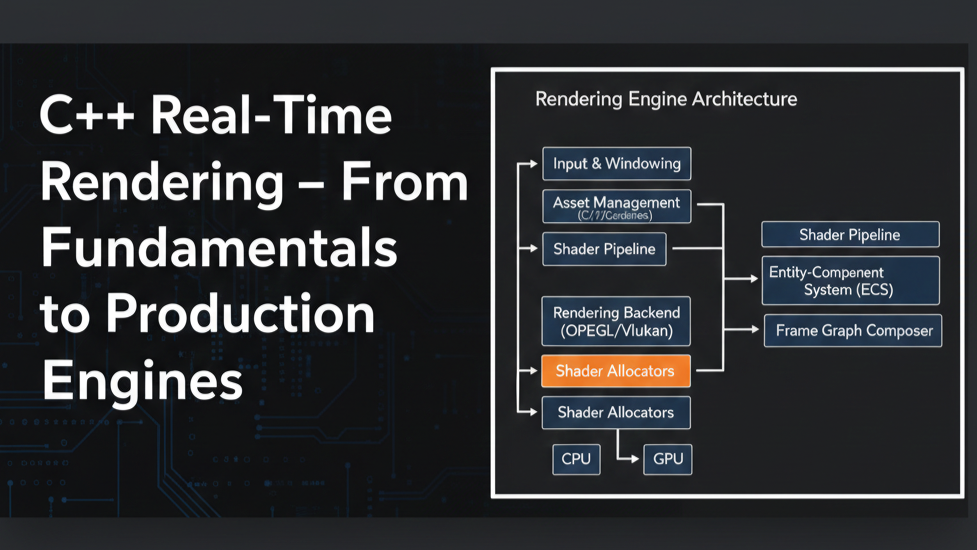
The capstone of this curriculum is a modular, high-performance rendering engine that leverages the best of both worlds: the conceptual simplicity of OpenGL for rapid prototyping and the explicit, multi-threaded power of Vulkan for production-ready performance. This dual-backend approach is an intentional architectural decision, allowing students to understand the evolution of graphics APIs and the trade-offs inherent in state-machine versus explicit-control designs.
Engine Technical Capabilities
The Target Audience: A Cross-Disciplinary Collective
This curriculum is designed for a broad spectrum of technical stakeholders, providing nuanced insights that empower each role to contribute to a high-performance system.
For Systems Engineers and Architects
The primary focus for these roles is the construction of a resilient, decoupled architecture. You will learn to design backends that hide the verbosity of Vulkan while exposing its performance benefits to high-level game logic. The curriculum emphasizes the "Frame Graph" concept, a declarative approach to frame construction that automatically manages resource transitions and barriers, reducing the risk of catastrophic driver failures.
For Product Managers and Designers
Product leaders will gain the mental model necessary to make informed trade-off decisions between visual fidelity and engineering speed. Designers will learn the technical constraints of the "Asset Pipeline," understanding why a specific mesh layout or texture format is critical for maintaining 60 frames per second on target hardware.
For SREs and DevOps Engineers
The course provides a deep dive into the modern graphics CI/CD pipeline. You will learn how to automate shader validation across different GPU vendors and how to implement "metamorphic testing" to catch silent rendering bugs in graphics drivers before they reach production.
Foundations: Prerequisites and Modern C++
Before the 90-day coding sprint begins, a baseline of technical proficiency is required. The engine relies on the C++23 standard, which introduces significant improvements in asynchronous programming and library support.
Mathematical Intuition over Raw Formulas
Real-time graphics is essentially the application of linear algebra in four dimensions. The curriculum prioritizes intuition. For instance, the dot product is not just a formula, it is a geometric tool for projection and measuring the cosine of the angle between light and a surface normal. This understanding is critical for calculating Lambertian diffuse lighting.
Modern C++ Systems Programming
We leverage C++20 and C++23 features to write robust, maintainable code. The use of "Concepts" allows us to constrain template parameters, providing clear compiler errors instead of the dreaded "template soup". Furthermore, the introduction of C++26’s experimental "Lifetime Tracking" ensures that we can manage raw GPU memory with a safety net that was previously only available in higher-level languages.
The 90-Day Master Curriculum: Day-by-Day Implementation
The course is structured into six phases of 15 days each, moving from the conceptual "MVP" to a production-ready "Hyperscale" architecture.
Phase 1: Engine Infrastructure and the OpenGL Prototyper (Days 1–15)
The goal of the first phase is to establish the core engine loop and a functional OpenGL 4.6 backend. This allows students to focus on the graphics pipeline basics without being overwhelmed by Vulkan's verbosity.
Day 1: The Modern Environment: Configuring CMake for C++23 modules and integrating the Vulkan SDK and GLM for math.
Day 2: Windowing and OS Abstraction: Wrapping GLFW to handle cross-platform window creation and input events.
Day 3: The High-Precision Game Loop: Implementing a deterministic update loop with a variable-rate render loop to avoid stuttering.
Day 4: Thread-Safe Logging: Building a logging infrastructure that utilizes C++23 std::format for low-latency diagnostic output.
Day 5: The OpenGL 4.6 Context: Initializing the API and setting up the debug callback to catch state errors early.
Day 6: Shader Modules and GLSL: Writing the first vertex and fragment shaders to understand the programmable pipeline.
Day 7: Vertex Buffer Objects (VBO): Mastering memory uploads. The transition from CPU arrays to GPU-resident memory.
Day 8: Vertex Array Objects (VAO): Defining the layout of vertex data so the GPU knows how to interpret interleaved attributes.
Day 9: The First Triangle: Drawing the basic primitive. This is the "Hello World" of systems engineering.
Day 10: Index Buffers and Reuse: Optimizing geometry by reusing vertex indices to reduce memory traffic.
Day 11: Uniforms and Constant Buffers: Implementing a system to pass global parameters like "Time" or "Resolution" to shaders.
Day 12: Matrix Transformations: Building the Model-View-Projection (MVP) pipeline. Transitioning from 3D world space to 2D screen space.
Day 13: Local, World, and Camera Spaces: Implementing the math behind reference frames and coordinate transformations.
Day 14: Quaternion-Based Rotation: Avoiding Gimbal Lock in the camera system by using quaternions instead of Euler angles.
Day 15: Input Mapping: Creating an event-driven input system that separates hardware keys from engine actions like "Jump" or "Move".
Phase 2: Physically Based Lighting and Asset Ingestion (Days 16–30)
In this phase, the engine moves from 2D placeholders to textured 3D objects with realistic light interactions.
Day 16: Depth Testing and the Z-Buffer: Solving the visibility problem so that closer objects correctly obscure distant ones.
Day 17: Texture Management: Loading PNG/JPG assets using stb_image and creating GPU texture objects.
Day 18: Filtering and Mipmaps: Understanding the trade-offs between linear filtering, anisotropy, and mip-level generation for distance quality.
Day 19: Alpha Blending and Transparency: Managing the render order for transparent fragments and understanding alpha-to-coverage.
Day 20: The First Person Camera: Implementing a smooth, quaternion-based camera controller for scene navigation.
Day 21: The Phong Lighting Model: Implementing ambient, diffuse, and specular components as a baseline for lighting.
Day 22: Light Attenuation: Modeling how light intensity falls off over distance using the inverse-square law.
Day 23: Normal Mapping and Tangent Space: Using textures to perturb surface normals, giving flat planes the appearance of high-poly detail.
Day 24: PBR Foundations: The micro-facet theory. Understanding how "roughness" and "metalness" maps govern light reflection.
Day 25: The Cook-Torrance BRDF: Implementing the mathematical model for physically based specular reflection.
Day 26: PBR Material Workflows: Standardizing the engine to handle roughness, metallic, and base color maps.
Day 27: Skyboxes and Cubemaps: Rendering the environment as a distant cubemap to provide context to the scene.
Day 28: Image-Based Lighting (IBL): Using the cubemap to calculate realistic ambient reflections on metallic surfaces.
Day 29: Offscreen Rendering (FBOs): Implementing framebuffers for post-processing and shadow mapping.
Day 30: Tone Mapping and HDR: Mapping high-dynamic-range light values into the viewable spectrum for modern monitors.
Phase 3: The Vulkan Descent (Days 31–45)
Phase 3 is the most challenging, as it requires rebuilding the backend in Vulkan to achieve explicit control and multi-threaded rendering.
Day 31: Vulkan Architecture Overview: Moving from a "Driver Managed" mindset to a "Developer Managed" mindset.
Day 32: The Vulkan Instance and Debugging: Setting up the API and the validation layers—essential for catching errors in explicit code.
Day 33: Physical Device Enumeration: Querying the GPU's capabilities and selecting the optimal hardware for graphics and compute.
Day 34: Logical Devices and Queue Families: Creating the software interface to the GPU and managing the work queues.
Day 35: The WSI and Swapchain: Managing the relationship between the engine and the operating system's window manager.
Day 36: Image Views and Framebuffers: Preparing the memory targets for the rendering operations.
Day 37: The Render Pass Declaration: Explicitly defining how the GPU should load and store data for each frame.
Day 38: Shader Modules and SPIR-V: Implementing a pipeline to compile GLSL into the binary format required by Vulkan.
Day 39: Pipeline Layouts and Bindings: Defining how uniforms and textures are mapped to shader slots.
Day 40: The Graphics Pipeline Object (PPO): Creating the immutable "state object" that governs the entire draw call.
Day 41: Command Pools and Recording: Building the system to record GPU instructions into reusable buffers.
Day 42: Synchronization: Fences and Semaphores: Mastering the most difficult part of Vulkan—ensuring the CPU and GPU don't step on each other.
Day 43: The Vulkan Triangle: Reaching parity with Phase 1. Why it took 10x more code to get the same result.
Day 44: Frames in Flight: Implementing a "Double/Triple Buffering" strategy to keep the CPU and GPU busy simultaneously.
Day 45: Swapchain Recreation: Handling window resize events without crashing the graphics context.
Phase 4: Systems Engineering—Memory, Assets, and Coroutines (Days 46–60)
The focus shifts to the "systems" aspect of the engine—managing high-speed data flow and memory safety.
Day 46: Sub-allocation Strategy: Building a custom memory manager to avoid the limit on the number of Vulkan allocations.
Day 47: Vulkan Memory Allocator (VMA): Integrating the industry-standard allocator to handle alignment and fragmentation.
Day 48: Staging Buffers and Transfers: Moving data from CPU RAM to the fast, "Device Local" memory on the GPU.
Day 49: Descriptor Pools and Sets: Managing the complex mapping of textures and buffers to shader resources.
Day 50: Dynamic Uniform Buffers: Optimizing world-matrix updates by using offsets in a single large buffer.
Day 51: Shader Storage Buffer Objects (SSBO): Utilizing unbounded memory for complex data structures inside the shaders.
Day 52: The Asset Pipeline Design: Building a system that converts GLTF/OBJ files into a proprietary, high-speed binary format.
Day 53: GLTF 2.0 Ingestion: Implementing a parser that extracts meshes, materials, and scene graphs from standard files.
Day 54: The Mesh Abstraction: Building a unified class that handles vertex/index data across both OpenGL and Vulkan.
Day 55: Texture Arrays and Samplers: Managing large numbers of textures without constant rebinding.
Day 56: C++23 Coroutines for I/O: Implementing co_await to load large files from disk without freezing the main thread.
Day 57: Asynchronous Texture Streaming: Building a background task system that uploads textures to the GPU as they arrive from disk.
Day 58: Material Archetypes: Creating a system that allows many objects to share the same shader and pipeline state.
Day 59: Basic Shadow Maps: Implementing the first depth-only render pass to generate shadow textures.
Day 60: Percentage Closer Filtering (PCF): Softening shadow edges through multi-sampling in the shader.
Phase 5: High-Scale Architecture—ECS and GPU Driven Pipelines (Days 61–75)
In this phase, we apply distributed systems principles to the engine to handle millions of objects.
Day 61: The Entity-Component System (ECS): Replacing object hierarchies with a flat, data-driven entity model.
Day 62: Data-Oriented Component Storage: Organizing memory so that similar components are contiguous, maximizing cache hits.
Day 63: The Scene Graph and Transforms: Implementing a hierarchical system to calculate world positions from parent offsets.
Day 64: CPU-Side Frustum Culling: Implementing a simple sphere-frustum check to skip rendering objects outside the camera view.
Day 65: GPU-Driven Culling with Compute Shaders: Moving the culling logic to the GPU to handle hundreds of thousands of objects in parallel.
Day 66: Multi-Draw Indirect (MDI): Using a single Vulkan command to draw thousands of culled objects at once.
Day 67: Bindless Rendering: Removing the need to bind descriptor sets per-object. Accessing all resources via a global table.
Day 68: The Frame Graph / Render Graph: Declaratively defining the frame's passes and letting the engine solve the dependencies.
Day 69: Automatic Resource Barrier Generation: Implementing a system to insert Vulkan barriers automatically based on the Frame Graph.
Day 70: Memory Aliasing and Transient Resources: Reusing the same GPU memory for different textures that don't exist simultaneously.
Day 71: Compute Shaders for Post-Effects: Implementing bloom and blurs using the flexible compute pipeline.
Day 72: Particle System Simulation: Moving simulation logic to the GPU to handle millions of particles.
Day 73: Order-Independent Transparency (OIT): Solving the transparency problem using linked lists in fragment shaders.
Day 74: Deferred Shading Architecture: Splitting the render into a G-buffer pass and a global lighting pass.
Day 75: Clustered Forward Shading: Optimizing scenes with many lights by binning lights into frustum clusters.
Phase 6: Production Tuning and CI/CD (Days 76–90)
The final phase focuses on the "production-ready" aspects of the engine—performance, reliability, and deployment.
Day 76: CPU Bottleneck Profiling: Using perf or VTune to find stalls in the engine's main thread.
Day 77: GPU Performance Analysis: Using RenderDoc and Nsight to identify expensive draw calls and memory stalls.
Day 78: Shader Optimization: Reducing register pressure and eliminating divergent branches to speed up the GPU.
Day 79: Profile-Guided Optimization (PGO): Using real-world usage data to re-compile the engine for specific hardware.
Day 80: Static Analysis and Sanitizers: Using AddressSanitizer and ThreadSanitizer to catch memory leaks and race conditions.
Day 81: Automated Shader Compilation in CI: Building a GitHub Action that compiles every shader for multiple vendors.
Day 82: Metamorphic Testing: Implementing a testing strategy that generates variants of shaders to catch driver bugs.
Day 83: Automated Performance Benchmarking: Integrating frame-time monitoring into the build pipeline.
Day 84: Cross-Platform Packaging: Creating AppImages for Linux and MSIX for Windows distribution.
Day 85: The Asset Pipeline CLI: Building a command-line tool for artists to convert assets in bulk.
Day 86: Technical Documentation: Writing an API guide using Doxygen to help other engineers use the engine.
Day 87: Trade-off Analysis: Ray Tracing vs. Rasterization: Implementing a prototype Ray Query to understand its performance cost.
Day 88: Final Engine Integration: Ensuring all subsystems (ECS, Vulkan, Assets, UI) work together in harmony.
Day 89: The Stress Test: Rendering a scene with 10 million triangles and 500 lights at a stable 60 FPS.
Day 90: Future Directions: Looking toward Mesh Shaders, Neural Post-Processing, and the future of C++26.
Role-Specific Learning Objectives
Each major participant in this course will emerge with clear, measurable achievements tailored to their professional needs.
For the System Engineer (Developer)
By Day 90, the developer will be able to implement custom memory managers that minimize heap fragmentation and design asynchronous resource loaders using C++23 coroutines. Success is defined by a codebase that remains stable under heavy load, with no memory leaks and a predictable frame time.
For the Software Architect (Designer)
Architects will master the "Frame Graph" abstraction, enabling them to design rendering pipelines that are decoupled from specific APIs. They will learn how to handle the complexity of multi-threaded command recording, ensuring that the engine scales linearly with the number of CPU cores.
For the Product Manager
Product leaders will gain a nuanced understanding of "Value Trade-offs". They will learn why certain features—like real-time ray-traced shadows—require significant hardware resources and how to balance "Simplicity over Comprehensiveness" to ensure a project remains on schedule.
For the Quality Assurance (QA) and SRE
QA engineers will learn to build automated visual testing frameworks. Success is measured by the ability to detect a 1% performance regression or a single-pixel rendering mismatch automatically across multiple GPU configurations.
The Modern C++26 Outlook: The Future of the Engine
The 2026 rendering engine is not just a tool for today; it is a platform for tomorrow. The upcoming C++26 standard promises "Integrated Reflection," which will revolutionize how we handle material parameters and shader bindings.
Reflection and Metaprogramming
Currently, passing data from a C++ struct to a GPU buffer requires manually mapping every field. With C++26 reflection, the engine will automatically generate the corresponding buffer layout, reducing a common source of bugs where CPU and GPU data structures become desynchronized.
Enhanced Concurrency Model
C++26 introduces a more robust task-graph framework, which we use in the later stages of the course to parallelize the "Command Recording" phase. This allows the engine to utilize every CPU thread to build the frame simultaneously, a critical requirement for high-scale simulation and rendering.
Architectural Trade-offs: Balancing Innovation and Stability
A senior systems designer knows that every technical choice is a trade-off. The curriculum explores these dilemmas in detail, providing architects with the tools to make informed decisions.
OpenGL vs. Vulkan: The Prototyping Paradox
While Vulkan offers superior performance, the "Time to First Pixel" is significantly higher. The curriculum uses OpenGL for the first 30 days to ensure students understand the concepts of rendering—lighting, math, and shading—before they tackle the mechanics of hardware control in Vulkan.
The "Sustained Velocity" Principle
In systems engineering, "speed" is often confused with "hurrying." We teach the principle of Sustained Velocity: building high-quality, well-documented code today so that the engine remains fast to modify tomorrow. Trading internal quality for a quick feature release creates technical debt that eventually brings development to a standstill.
Conclusion: Mastering the Invisible Machine
Building a real-time rendering engine in modern C++ is more than an exercise in graphics; it is a masterclass in modern systems design. By reconciling the high-level elegance of C++23/26 with the low-level brutality of the Vulkan API, the engineer gains a rare and valuable perspective on how computers actually work.
This 90-day curriculum provides a rigorous, hands-on path from basic concepts to production-grade architecture. Whether the goal is to build a commercial game, an industrial visualization tool, or a high-performance simulation platform, the skills learned here—memory sub-allocation, asynchronous streaming, data-oriented design, and automated validation—are the foundations of 21st-century engineering excellence. At the end of the journey, the engineer does not just possess a rendering engine; they possess the mastery to build any ultra-high-scale, performance-critical system the future requires.