
Start building with us today.
Buy this course — $175.00Flutter App Development: Build a Travel Booking App from Scratch
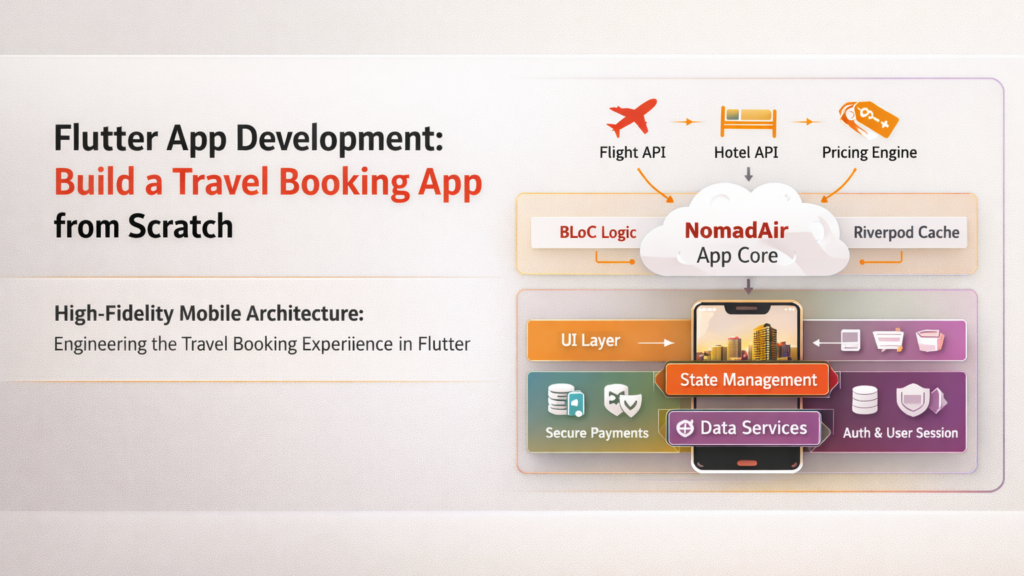
High-Fidelity Mobile Architecture: Engineering the Travel Booking Experience in Flutter
The travel app industry has undergone a radical transformation, evolving from simple reservation portals into highly sophisticated, $1 trillion ecosystems that demand near-native performance and bespoke aesthetic quality. In the contemporary landscape of 2025 and 2026, the success of a travel platform is predicated not merely on the utility of booking a flight, but on the fluidity and emotional resonance of the digital experience. As mobile users increasingly anticipate hyper-personalized, "alive" interfaces that react to their context and behavior, developers face the challenge of building apps that are both visually rich and architecturally resilient. This report details a comprehensive, expert-level course designed for senior engineers and aspiring architects, focusing on the construction of "NomadAir," a production-ready travel booking application. The curriculum emphasizes the intersection of high-performance rendering—bridging the gap between mobile and game development—and robust system design tailored for the volatility of the aviation and hospitality sectors.
Why This Course?
The decision to architect a travel booking engine in Flutter is a strategic response to the shifting economic and technical realities of the mobile market. Following the pandemic, major travel entities like Travelstart utilized Flutter to reduce mobile engineering teams by 60% while achieving a 90% reduction in codebase size. However, as technical quality becomes standardized across the industry, competitive advantage has shifted toward visual identity and brand consistency. Standard, off-the-shelf Material Design components are no longer sufficient to differentiate a product in a crowded market; instead, enterprises are investing in proprietary, closed design systems that enforce a distinct visual language.
This course is engineered to address the "messy middle" of the travel journey—the gap between initial inspiration and the final transaction. While many tutorials focus on simple CRUD operations, the reality of travel engineering involves handling high-volatility pricing, real-time inventory locking, and complex synchronization across Global Distribution Systems (GDS) like Sabre and Amadeus. By focusing on intuition and production-ready architecture, this course prepares developers to build systems that survive the unpredictable nature of mobile environments, characterized by fluctuating connectivity and limited resource constraints.
The curriculum also recognizes the convergence of mobile and game development. The modern Flutter developer must understand the rendering pipeline as a graphics engineer would, utilizing the Impeller engine to eliminate shader compilation jank and leveraging CustomPainter to build organic, interactive interfaces that standard widgets cannot provide. The move toward WebAssembly (Wasm) as a default compilation target for the web further underscores the need for high-performance, compute-intensive logic that rivals native execution.
What You'll Build
The centerpiece of this curriculum is "NomadAir," a multifaceted flight and hotel booking platform that serves as a laboratory for advanced Flutter techniques. This is not a toy application; it is a simulated enterprise environment where every engineering choice must be justified against performance and scalability benchmarks. NomadAir implements a vertical "Discovery Feed" that translates short-form travel videos into instant bookings, ensuring that user intent remains within the ecosystem.
The application features an interactive, SVG-driven seat map engine built entirely with CustomPainter and GestureDetector. This engine allows for granular control over seat selection, handling the geometric complexity of various aircraft layouts while maintaining real-time parity with backend inventory. Furthermore, NomadAir incorporates a "Price Freeze" module, utilizing machine learning models to predict fare trends and allowing users to lock in prices for a deposit—a feature pioneered by Hopper to reduce booking anxiety.
Architecturally, the project demonstrates a hybrid state management strategy. It employs Riverpod 3.0 for its reactive caching and native offline persistence, ensuring that itineraries are accessible even in the absence of a network connection. For the transaction-heavy checkout and payment flows, the app utilizes BLoC 9.0 to provide an event-driven audit trail, crucial for industries where state integrity is non-negotiable. This dual-approach prepares the engineer to make nuanced trade-offs between simplicity and robustness.
Who Should Take This Course?
This course is tailored for the senior engineer or the mid-level developer looking to transcend the "widget-layer" of Flutter. It is designed for those who must architect systems that scale across large teams and complex domains. The ideal participant is a professional who values architectural discipline and seeks to understand the "why" behind the "how."
The curriculum is particularly relevant for:
Mobile Solutions Architects: Professionals tasked with designing multi-platform systems that must integrate with legacy travel infrastructure and modern cloud services.
High-Performance UI/UX Developers: Engineers who want to master the Flutter rendering pipeline, custom shaders, and shared-element transitions to create "cinema-quality" mobile experiences.
Game-to-Mobile Convergers: Developers with a background in graphics programming who want to leverage Flutter's low-level APIs for non-standard, interactive UIs.
Fintech and Travel Engineers: Those dealing with high-precision currency math, timezone logic, and the intricacies of Global Distribution Systems.
What Makes This Course Different?
The NomadAir Masterclass distinguishes itself by treating mobile development as a discipline of trade-offs rather than a collection of features. It moves beyond the "happy path" tutorials found in most bootcamps, forcing the student to confront the realities of connectivity variability, resource limits, and data integrity. The course utilizes the SCADET framework (System, Design, Architecture, Evaluation, Trade-offs) to evaluate every major architectural decision.
A significant differentiator is the focus on "Mobile System Design." Participants do not just learn to draw a button; they learn how to design an optimistic UI update that masks a 3-second server latency while maintaining a graceful rollback strategy in case of failure. The course also dives deep into the rendering pipeline, teaching students how to pre-compile shaders to eliminate jank—a common pain point in visually rich Flutter applications—and how to use the Impeller engine to achieve consistent 60fps animations on mid-range devices.
Furthermore, the curriculum is updated for 2026 standards, including the use of Riverpod 3.0’s native persistence and the decoupling of Material and Cupertino libraries from the core framework, allowing for faster update cycles and more bespoke design systems. This forward-looking approach ensures that the skills acquired are relevant for the next generation of mobile platforms.
Key Topics Covered
The technical depth of this course spans the entire stack of a modern mobile application, with a particular focus on the unique challenges of the travel industry.
Advanced Rendering and Custom UI
The course explores the limits of the Flutter rendering pipeline. This includes mastering CustomPainter to draw complex seat maps and data visualizations, as well as utilizing fragment shaders for atmospheric effects like glassmorphism and frosted glass. Students learn to parse SVG data into native Path objects, enabling organic curves that respond to user touch with surgical precision.
Resilience and Systems Engineering
Building for travel means building for volatility. The curriculum covers the implementation of "Optimistic State," where changes are instantly reflected in the UI while background processes confirm success with the server. This is paired with sophisticated rollback logic and transaction IDs to ensure that a failed booking does not leave the user in an inconsistent state. We also explore "Offline-First" architecture, leveraging Riverpod 3.0 to synchronize local and remote data sources automatically.
High-Precision Financials and Temporal Logic
Handling currency and time across borders is a primary source of bugs in travel apps. The course provides deep-dives into fixed-decimal math to avoid floating-point errors and the use of the IANA timezone database to calculate multi-leg flight durations across daylight savings boundaries.
Backend Orchestration and GDS
The "NomadAir" app integrates with Global Distribution Systems like Sabre. The course teaches patterns for "middleware orchestration," where complex, legacy SOAP/XML responses from GDS providers are normalized into clean, modern REST/JSON for the mobile client. We also cover inventory locking strategies to prevent the "double-booking" problem during the critical checkout window.
Prerequisites
To maximize the benefits of this course, participants should have a professional background in software engineering and a working knowledge of the Flutter framework.
Dart Mastery: Proficiency in asynchronous programming (Futures/Streams), mixins, and extension methods.
Flutter Foundation: Understanding of the widget lifecycle, basic state management (Provider or setState), and standard layout widgets.
Architecture Basics: Familiarity with clean architecture principles and general design patterns (Singleton, Factory, Observer).
Technical Environment: A machine capable of running the Flutter SDK (version 3.35 or higher) and mobile emulators, along with a basic understanding of Git workflows.
Course Structure
The curriculum is organized into ten thematic modules, each containing nine intensive lessons. This structure follows the lifecycle of a production-grade project, moving from high-level system design to granular optimization and deployment. Each module concludes with a "Mastery Challenge" where students must apply the module's concepts to the NomadAir codebase.
Curriculum: The 90-Lesson Roadmap
The following curriculum provides an exhaustive path toward mastering Flutter for high-scale travel applications.
Module 1: Foundations of Premium UX (Lessons 1-9)
This module establishes the philosophical and visual foundation of the course, focusing on why "good enough" UI is no longer a viable strategy.
The $1T Opportunity: Analyzing the business of travel and why mobile UX is the primary differentiator in 2026.
Beyond Material: Breaking the "Google-Style" mold and architecting a proprietary design system.
The Psychology of Motion: Using micro-animations and Material Expressive to create "alive" interfaces.
Glassmorphism and Depth: Implementing frosted glass effects and layered hierarchies without sacrificing FPS.
Inclusive Architecture: Designing for neurodivergent travelers and implementing WCAG 2.1 at the component level.
Video-First Discovery: Designing high-performance vertical feeds inspired by "Airbnb Scrolls".
Adaptive Design: Strategies for supporting foldables, tablets, and mobile with a single responsive codebase.
Haptic Feedback Systems: Using tactile cues to build confidence in transaction-heavy flows.
Dark Mode as a First-Class Citizen: Managing contrast and brand recognition across lighting themes.
Module 2: Architectural Blueprints (Lessons 10-18)
In this module, we transition from design to system architecture, setting up a scalable, multi-package project structure.
The SCADET Framework: Applying mobile system design principles to NomadAir.
Multi-Package Architecture: Decoupling the data, domain, and UI layers for team scalability.
The Hybrid State Strategy: Integrating Riverpod for caching and BLoC for transactions.
Riverpod 3.0 Deep Dive: Understanding reactive caching and the modern data-binding framework.
BLoC 9.0 and Cubit: Event-driven logic for strict architectural separation.
Immutability First: Using Freezed to build robust, predictable data models.
Dependency Injection: Managing services and repositories with a clean locator pattern.
Error Handling Architecture: Implementing functional "Result" types for reliable exception management.
The Mocking Layer: Building a robust testing environment with mock states and transaction IDs.
Module 3: The Custom Rendering Engine (Lessons 19-27)
This module bridges the gap between mobile and game development, focusing on the geometry of the airplane seat map.
The Rendering Pipeline: Deep dive into the Widget, Element, and RenderObject trees.
CustomPainter Foundations: Mastering the Canvas and drawing surgical-grade geometry.
SVG to Path Translation: Parsing aircraft layouts into interactive, scalable paths.
Advanced Hit Testing: Detecting taps on irregular shapes and dynamic polygons in the seat map.
Interactive Seat Mechanics: Implementing seat selection, category coloring, and availability states.
PathMetrics and Animation: Animating flight paths and organic curves on a global map.
The Semantics Builder: Making custom-drawn interfaces fully accessible to assistive technologies.
Optimizing Repaints: Using RepaintBoundary and keys to isolate complex drawing logic.
Custom Shaders: Integrating GLSL for atmospheric weather and frost effects in the UI.
Module 4: Dynamic State and Mutations (Lessons 28-36)
We focus on the volatile logic of flight pricing and the new Riverpod 3.0 Mutations API.
Riverpod 3.0 Mutations: Streamlining data writes (Login, Booking) with lifecycle state exposure.
The Price Freeze Logic: Implementing insurance-style features with complex state transitions.
Optimistic UI Implementation: Masking network latency with instant state transitions.
Graceful Rollback Strategies: Managing API failures in an optimistic environment.
Real-Time Fare Alerts: Managing WebSocket streams for instant price-drop notifications.
Complex Form State: Managing multi-step checkout with global keys and validation mixins.
Search and Filter Logic: Architecting high-performance search with debouncing and local caching.
The Mutation Lifecycle: Handling Idle, Pending, Success, and Error states in a unified UI.
State Persistence: Using hydrated_bloc and Riverpod native persistence for app-wide state.
Module 5: Transitions, Navigation, and Storytelling (Lessons 37-45)
This module focuses on visual continuity and moving users through the booking funnel with "cinema-quality" motion.
Hero Animations: Shared element transitions for moving from discovery to detail.
Custom Flight Shuttle Builders: Controlling the "flight" of widgets between routes.
Shared Z-Axis Motion: Implementing depth-aware transitions via Material motion.
PageRouteBuilder: Crafting bespoke route transitions (Fade, Scale, Slide) from scratch.
Navigation Orchestration: Implementing the Coordinator pattern for complex multi-screen flows.
Sliver-Based Storytelling: Using custom slivers to create immersive, scrolling search results.
Implicit vs. Explicit Animation: When to use AnimatedContainer vs. AnimationController.
Lottie Integration: Adding interactive, vector-based animations for "success" moments.
Animation Profiling: Identifying dropped frames and GPU bottlenecks in transitions.
Module 6: Financial Engineering and Temporal Logic (Lessons 46-54)
Accuracy is paramount. We tackle the math of money and time in a global context.
Money2 Integration: Using fixed-decimal math to eliminate rounding errors in totals.
Multi-Currency Presentation: Localizing prices, symbols, and separators for global markets.
Dynamic Exchange Rates: Fetching and applying FX rates with consistent precision.
The Timezone Problem: Using the IANA database and TZDateTime for flight scheduling.
Multi-Leg Calculations: Calculating total travel time across multiple timezone shifts.
"Wall Time" vs. UTC: Storing future event intentions safely in the database.
Number Formatting: Bridging the gap between intl and BigDecimal for localized UIs.
Right-to-Left (RTL) Logic: Adapting the entire layout and directionality for global locales.
Financial Persistence: Best practices for storing monetary values in SQLite and Firestore.
Module 7: Backend Orchestration and GDS Connectivity (Lessons 55-63)
NomadAir must communicate with the complex, legacy infrastructure of the travel world.
GDS Overview: Integrating with Sabre, Amadeus, and Travelport.
Middleware Patterns: Normalizing legacy XML/SOAP into clean REST/JSON for the app.
Inventory Management System: Architecture for real-time stock sync and multi-channel updates.
The Double-Booking Problem: Implementing pessimistic locking for seat and room reservations.
Optimistic Concurrency Control: Using version IDs to prevent conflicting booking updates.
Payment Orchestration: Securely handling Stripe/PayPal integrations in the mobile flow.
Fare Volatility Monitoring: Building dashboards to track dynamic pricing latency.
API Gateways: Managing authentication, rate limiting, and session tokens.
Distributed Caching: Using Redis to speed up flight search results across regions.
Module 8: Graphics Optimization and the Impeller Engine (Lessons 64-72)
We ensure the app remains blazing fast, even with custom shaders and complex geometry.
The Impeller Renderer: Enabling ahead-of-time (AOT) shader compilation for iOS and Android.
Shader Warm-Up: Generating and bundling shaders_warmup.json for older devices.
Tree-Shaking and Code Splitting: Reducing the JavaScript bundle size for the web target.
WebAssembly (Wasm): Compiling NomadAir for near-native web performance.
Efficient Widget Trees: Reducing rebuild frequency by 50% through surgical widget management.
Image Asset Optimization: Using WebP and memCacheWidth to save memory.
ListView.builder Performance: Handling unbounded lists and infinite scrolls with virtualization.
Memory Leak Detection: Using DevTools to find and fix persistent objects.
Release Mode Profiling: Measuring real-world startup and frame render times.
Module 9: Data Persistence and Resilient Architectures (Lessons 73-81)
NomadAir must survive the "messy reality" of intermittent flight connectivity.
Offline-First Resilience: Architecting for "stale-while-revalidate" data access.
Native Riverpod Hydration: Automatically persisting provider state to local storage.
Background Sync: Updating flight statuses while the app is in the background.
SQLite vs. NoSQL: Choosing the right local storage engine for complex itineraries.
Conflict Handling: Strategies for reconciling offline user changes with server state.
Automatic Retry Logic: Using exponential backoff for failed network requests.
Secure Storage: Protecting PII (Personally Identifiable Information) on-device.
Hydration Lifecycle: Handling the sync between local data and remote refreshes.
Testing Resilience: Using Integration Tests to simulate network drops and recoveries.
Module 10: Production Readiness and Launch (Lessons 82-90)
The final stage focuses on the rigor of deploying an enterprise travel app.
Unit Testing Business Logic: Writing fast, millisecond-level tests for BLoCs and Notifiers.
Widget and Goldens Testing: Ensuring UI consistency across different screen densities.
Integration Testing: Running end-to-end booking flows on real physical devices.
CI/CD Pipelines: Automating builds and deployments with Codemagic or GitHub Actions.
Code Obfuscation: Securing the application binary against reverse engineering.
Performance Monitoring: Integrating Firebase Performance to track production jank.
App Store Optimization (ASO): Preparing high-fidelity visuals and metadata for the stores.
Rollout Strategies: Feature flagging and phased releases to minimize risk.
Final Project Ceremony: Architectural audit and the launch of the NomadAir beta.
Implementation Insights: The NomadAir Strategy
To effectively teach these 90 lessons, the course adopts a "mentor-mentee" dialogue, where every lesson is a session at a digital whiteboard.
State Management: The Hybrid Trade-off
Choosing between BLoC and Riverpod is often presented as a binary choice, but for NomadAir, it is a nuanced architectural decision.
Optimizing for the Impeller Engine
A key technical insight integrated into Module 8 is the transition from Skia to Impeller. Students learn that Impeller solves the "shader jank" problem by using a tessellation-based approach that does not require runtime shader compilation. We teach the specific Gradle and Xcode configurations required to enable this, along with the profiling tools needed to verify that the app is consistently hitting sub-16ms frame times even during complex shared-element transitions.
Conclusion
Building a travel booking experience in 2026 is an exercise in managing complexity with elegance. As the industry moves toward a $1 trillion valuation, the demand for senior engineers who can bridge the gap between high-performance graphics and robust backend orchestration will only intensify. Through the 90-lesson curriculum of the NomadAir Masterclass, developers gain the architectural intuition needed to navigate the trade-offs of modern mobile development—balancing speed against resource limits, simplicity against scalability, and beauty against performance. By mastering custom rendering, hybrid state management, and resilient system design, the engineer is empowered to build not just an app, but a world-class digital product that sets a new standard for the travel industry.
GitHub Repository
Explore the complete codebase and implementation:
View on GitHub